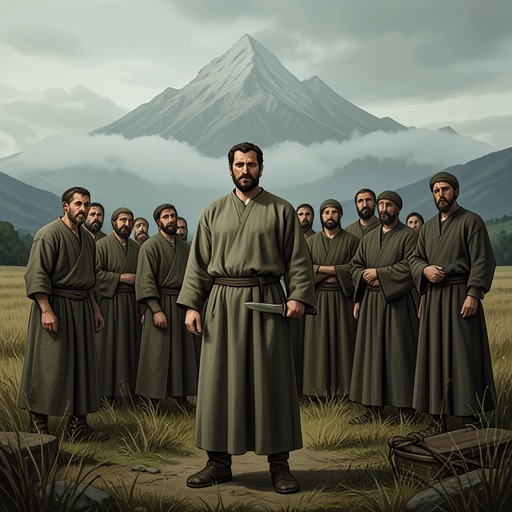
John D. Lee
Under the Banner of HeavenJohn D. Lee occupies a central place in the account of the Mountain Meadows massacre: a trusted, obedient churchman who helped turn a siege into a mass killing, then became the one man publicly punished for a crime the narrative describes as involving many others. His trajectory—from valued agent of Brigham Young to isolated fugitive and condemned scapegoat—makes his story a study in how authority, obedience, and responsibility could diverge.
Identity and Standing
At forty-four, Lee was a battle-tested veteran of the conflicts in Missouri and Illinois, and the book portrays him as intensely devoted to the Church and its leaders. He was also a forceful, unpopular figure among some of his peers, described as a blustering martinet whose eagerness to ingratiate himself did little to win their affection. Brigham Young, however, valued his unquestioning obedience and felt genuine affection for him.
Their bond had been made explicit through a Mormon adoption ritual in Nauvoo, in which Brigham adopted Lee as his symbolic son. In 1856, Brigham appointed him Farmer to the Indians, making Lee his personal representative to the Southern Paiute. The appointment placed him between church leadership and the Paiute community, a position that would become significant when he later led an attack involving both Paiutes and Mormon militiamen.
The relationship existed within a religious order in which church authority could carry political and practical force. The book describes Brigham’s Utah as a place where leaders asserted that divine law outranked civil law and where local institutions were shaped by Mormon control. Lee’s importance in this structure rested less on an independent public position than on his usefulness as a loyal intermediary and commander.
From Brigham Young’s Agent to the Mountain Meadows Attack
The Fancher emigrant party’s arrival in southern Utah unfolded amid heightened fear and hostility toward outsiders. Rumors circulating in Cedar City portrayed the Arkansas travelers as enemies of the Saints, and the party was refused food when it passed through. According to Lee’s account, Lieutenant Colonel Isaac Haight ordered him to assemble Paiute leaders, arm their warriors, and lead an ambush. Haight presented the order as the will of those in authority.
Lee and a combined force of Saints and Paiutes reached the hills above Mountain Meadows and watched the emigrants camp near a spring. Mormon participants painted their faces to resemble Indians before the attack. The emigrants resisted the initial assault by circling their wagons and taking defensive positions, frustrating the attackers’ expectation of a quick victory. As the siege continued and most of the Paiutes left, the Mormon leaders turned to deception.
On September 11, Lee sent William Bateman to the emigrants under a white flag with a false offer of protection. The emigrants were told that the Mormons would escort them past the hostile Paiutes if they surrendered their weapons. Lee then entered their defenses and persuaded them to accept the terms. Once the party had given up its arms, the emigrants were separated into groups and led away under Mormon guard. At a prearranged signal, the guards killed their captives; other attackers, including Mormons disguised as Indians, killed the women and children. About 120 people died. Seventeen children, all no older than five, were spared.
The killings were followed by looting and a rushed attempt to hide the bodies. When Haight and Colonel William Dame arrived the next morning, Lee escorted them across the scene. Lee’s account presents Haight and Dame arguing over responsibility: Haight said Dame had ordered the attack, while Dame protested that he had not expected its scale. The disagreement did not undo their shared involvement, but it foreshadowed the struggle over who would eventually bear the blame.
After the burial, the Saints gathered and gave thanks for their enemies’ defeat, according to Lee’s later account. The participants then agreed to claim that the Paiutes alone had carried out the killings and that the Mormons had played no part. They also threatened death for anyone who revealed who had been present. The cover story made Lee’s later fate especially stark: the man who had helped direct the attack and concealment would ultimately be made to answer for the wider group.
Flight, Exile, and the Cost of Obedience
In the years after the massacre, many culpable Saints moved to remote settlements to evade their pursuers. Lee did not readily leave. He had become the wealthiest man in southern Utah, owned several homes, and had eighteen wives. When federal efforts intensified under President Ulysses S. Grant in 1869, Brigham advised him to sell his property and make himself scarce. Lee refused, instead retreating into the nearby hills when federal agents or bounty hunters came close.
During an expedition with John Wesley Powell in September 1870, Brigham again told Lee to move away from Washington and Iron Counties and settle in a remote valley with his family. Lee’s reluctant response did not prevent Brigham from insisting. About a month later, Brigham excommunicated him and sent him to the upper end of the Grand Canyon, where he ran a ferry service across the Colorado River. Lee called the isolated settlement Lonely Dell; it later became known as Lee’s Ferry. Eleven of his wives divorced him, and only two of his remaining spouses joined him there. His exile removed him from the community whose leaders he had obeyed, while leaving him exposed to the legal consequences of the massacre.
Trials and the Making of a Scapegoat
In November 1874, U.S. Marshal William Stokes found Lee hiding beneath straw in a chicken coop in Panguitch, where he was visiting one of his remaining wives. Lee’s first trial, held in Beaver eight months later, ended with a deadlocked jury. The failure to convict intensified public anger and anti-Mormon pressure. Brigham responded by abandoning the claim that the Paiutes alone were responsible and changing course: Lee would be presented as the person to blame.
At Lee’s second trial in 1876, the LDS First Presidency screened the jurors, all of whom were Mormons. The account argues that the selection was intended to ensure that Lee alone would be convicted. Jacob Hamblin, who had not been at Mountain Meadows during the massacre, became the prosecution’s key witness; the book characterizes his testimony as convincing but perjured. The trial, in this telling, gathered the culpability of the many participants onto Lee. On September 20, the jury found him guilty of first-degree murder, and the court sentenced him to death.
While awaiting execution, Lee wrote the account of his life later published as Mormonism Unveiled, a national bestseller. In it, he maintained that he had acted under orders from church leaders and had remained obedient until Brigham abandoned him. His defense did not erase his own role in leading the attack, but it directly challenged the idea that his guilt could be separated from the authority structure that had directed and protected him.
Execution and Narrative Significance
On March 23, 1877, Lee returned to Mountain Meadows for the first time in twenty years. With about eighty people watching, he completed his will, sat on the coffin intended for his body, and listened as the marshal read the death warrant. He told the crowd that he was being sacrificed. Before the firing squad acted, he asked that the bullets pass through his heart and that his body not be mangled. He was executed by firing squad at the site of the massacre.
Lee’s ending brings the book’s account of obedience and institutional responsibility into focus. He was neither portrayed simply as an outsider to the church’s authority nor absolved as a passive instrument: he commanded the attack, used deception to obtain the emigrants’ surrender, and joined the concealment afterward. Yet the narrative also emphasizes that orders passed through a chain of church and militia leaders, while the public prosecution ultimately concentrated the crime on Lee. His life therefore ends in a double accusation—against his own actions and against the system that had relied on his obedience, then left him to carry the blame.